

From cloned gene to museum display: a scientist’s journey
For 2Blades Vice President and Group Leader, Kamil Witek, the progress of late blight-resistant potatoes is more than a scientific milestone. It is a journey of years spent seeking resistance genes, protecting them, building partnerships around them – and, most recently, showing his son how that work has become part of a public story about the future of food.
Years before a disease-resistant Maris Piper potato appeared in London’s Science Museum, Kamil Witek was working at the laboratory bench in Norwich, searching the DNA of wild potato relatives for a better way to stop late blight.
He was a scientist in Professor Jonathan Jones’s group at The Sainsbury Laboratory (TSL), where researchers were studying the natural immune systems plants use to recognize and fight disease. Their target was Phytophthora infestans, the fast-evolving pathogen responsible for late blight – the disease associated with the Irish Potato Famine and still one of the most destructive threats to potatoes worldwide.
Most commercial potato varieties are vulnerable to late blight, but wild relatives contain a rich diversity of natural resistance. Finding the individual genes responsible was the start, but turning the promise into something tangible has taken years of painstaking work.
Working in Jonathan Jones’ lab, Kamil sought late blight and other resistance genes from a wild, non-tuber-bearing relative of potato, Solanum americanum. One of these genes, Rpi-amr3, encodes an immune receptor that recognizes the pathogen and triggers the plant’s natural defenses. Together they showed that Rpi-amr3 could confer that same protection to domesticated potato.
Disease resistance traits like these are highly valuable to agriculture, helping farmers protect their harvests. Farmers will pay a little more for better varieties, and potato companies will invest to bring those traits to them. The investment to develop and test new traits often depends on a time-limited right to exclude others – a patent.
Enter 2Blades, who took on the patent filing process and costs and pursued the licensing of rights for product development. Witek and Jones are named inventors on the patent covering the gene and its uses.
But discovery was only the beginning.
Giving discovery a route to benefit agriculture
2Blades was created to bridge the difficult distance between discovering a disease-resistance gene and delivering it as a useful crop trait. Breakthrough science alone is not enough. Promising genes must be validated, protected, combined with complementary traits, licensed to capable partners and carried through years of crop development and regulation.
2Blades supported the resistance-gene research in Jonathan’s group by protecting key discoveries through patents; not to keep them under lock and key, but to forge a path to market. Intellectual property can give commercial partners the confidence to invest the considerable time and resources needed to transform a laboratory result into a farmer-ready variety. The process of licensing also allows 2Blades to ensure that genes are used responsibly – creating durable resistance in combination with other control measures – a core part of its mission.
This approach led to a partnership among 2Blades, TSL and the J.R. Simplot Company. The partners set out to discover, license, and deploy new sources of late blight resistance. Simplot’s Generation 2 Innate® potatoes containing Rpi-amr3 went through stringent product development, regulatory clearance, and marketing to find their way into the hands of potato growers and also Witek himself, at a visit to Simplot.
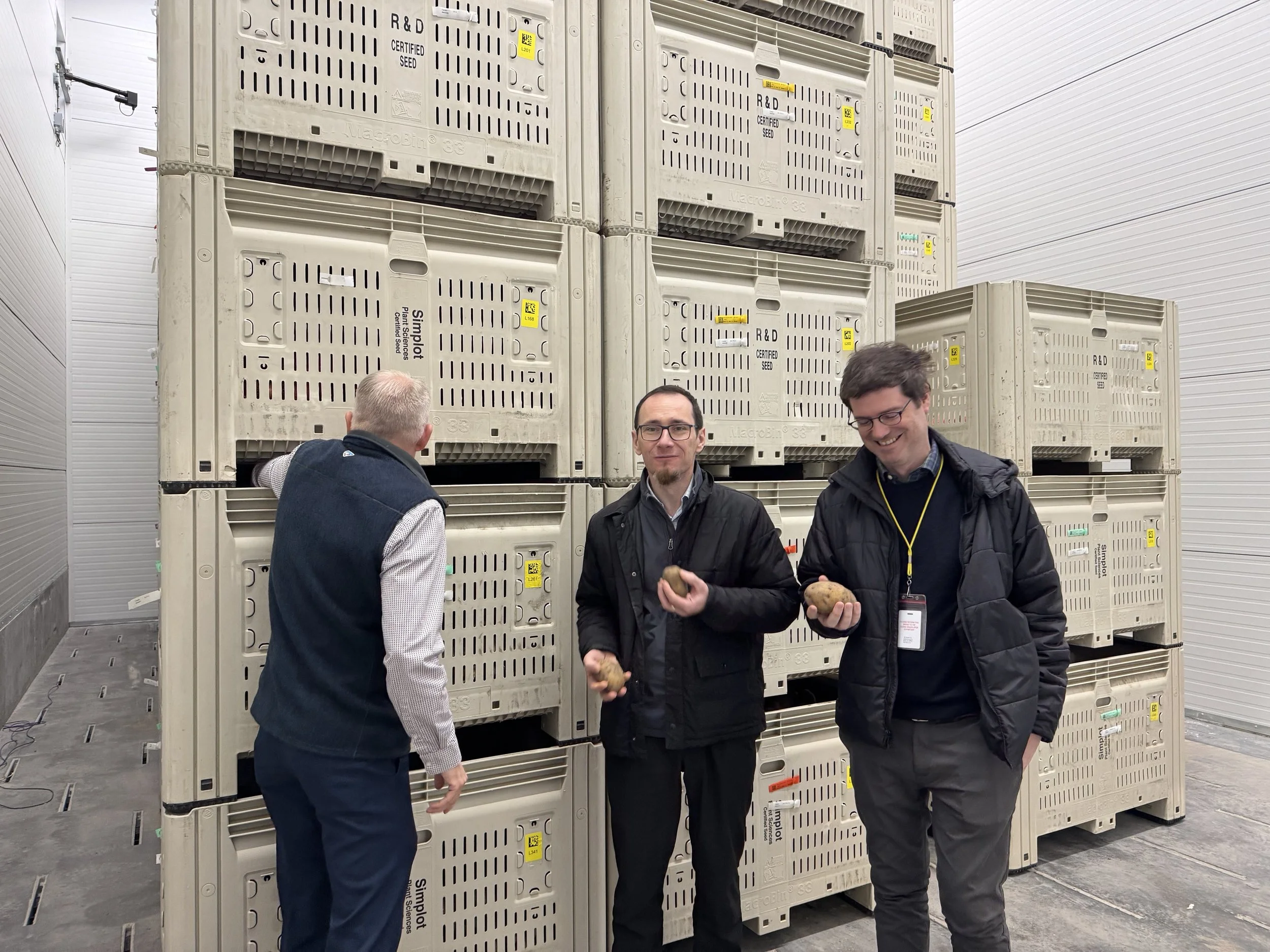
2Blades Kamil Witek and Jack Luft at Simplot holding Innate potato varieties protected against late blight disease by Rpi-amr3, ready for shipping.
It was an early demonstration of the model Kamil’s work follows now within 2Blades: discover a powerful natural defense, protect it, and place it with a partner capable of bringing improved crops to the market.
Coming to market in Britain, where it all started
Today, that journey is advancing on both sides of the Atlantic. In the United States, Simplot has shown that late blight resistance can be incorporated into commercial potato varieties and taken through the regulatory system. In Britain, a new policy environment is now opening a route for similar biological solutions in familiar UK varieties.
In July 2026, two lines of PiperPlus – a Maris Piper derivative strengthened with resistance to late blight, Potato Virus Y and Potato Leafroll Virus – received the UK’s first precision-bred potato marketing notice under the Genetic Technology (Precision Breeding) Act 2023. The decision confirms that the lines meet the legal definition of a precision-bred organism and moves the potatoes a significant step closer to farmers.
BioPotatoes, TSL’s commercialization partner, is leading the effort to bring these protected varieties to commercial and home growers. Its initial pipeline pairs disease resistance with varieties the British market already values: Maris Piper, creating PiperPlus, and Charlotte, creating CharlottePlus. 2Blades licensed these traits to BioPotato on accessible terms, to help ensure that these important resistance discoveries reach market and create value for British growers.
The potential benefits are substantial. British potato growers may spray susceptible crops against late blight as many as 15 times in a season. A potato able to recognize and stop the pathogen itself could reduce fungicide use, production costs, tractor journeys, emissions and soil compaction. Virus resistance could reduce insecticide use and make it easier to produce clean seed potatoes in England.
PiperPlus is not yet on supermarket shelves. Food Standards Agency review, variety registration and the multiplication of sufficient seed potatoes still lie ahead. But its precision-bred approval is a landmark: decades of research into natural plant immunity are moving from the laboratory and into a defined route to the UK market.
A family visit – and a full-circle moment
The story took on a personal dimension when Kamil visited the Science Museum in London with his family.
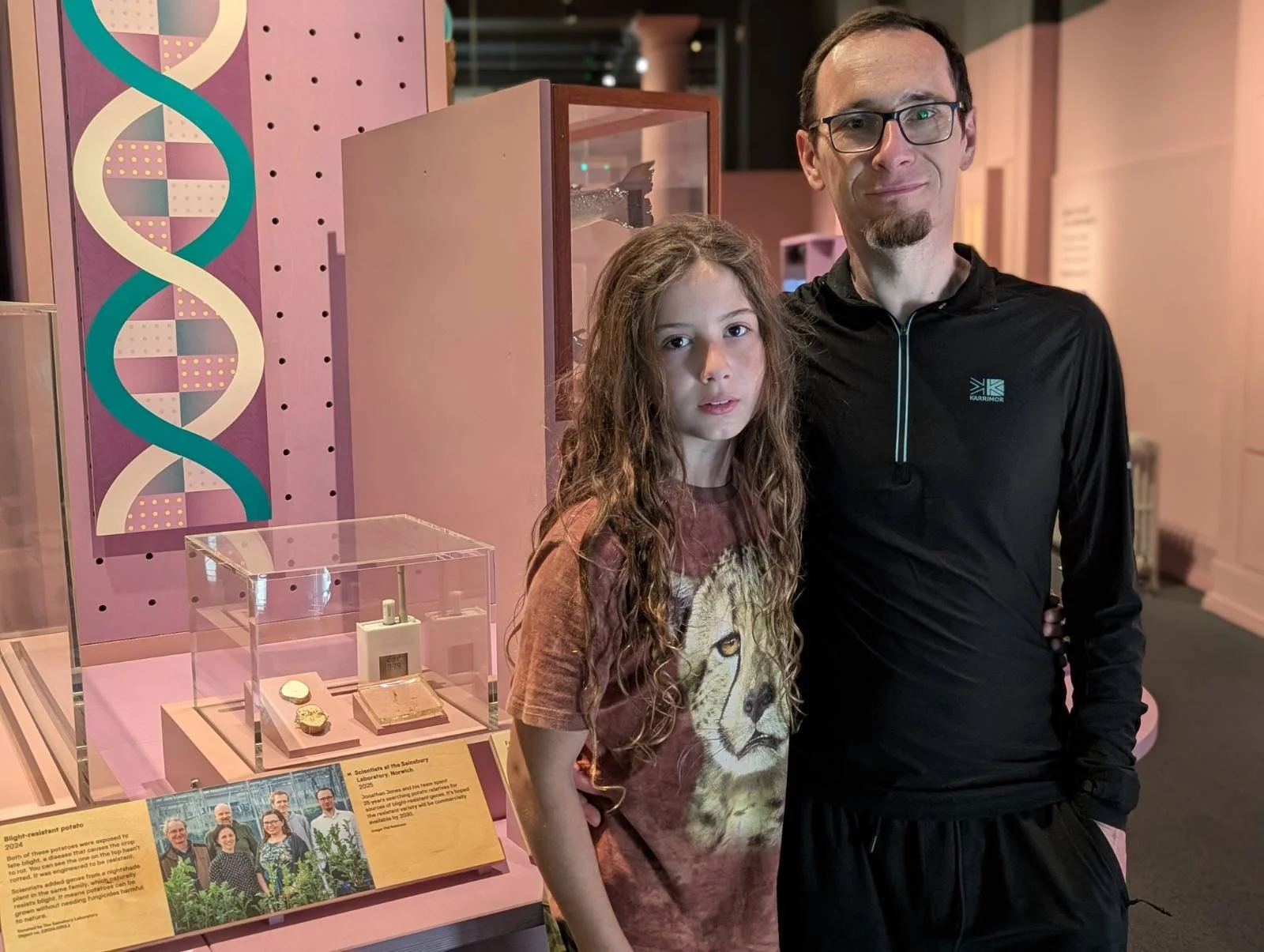
Kamil Witek and son visit the Piper Plus exhibit at the Science Museum of London.
There, in the museum’s Future of Food exhibition, a PiperPlus potato containing Rpi-amr3 was displayed beside a conventional, disease-susceptible Maris Piper. The comparison showed visitors how genes from wild potato relatives can help a familiar crop defend itself, replacing some of the chemistry used in crop protection with biology.
Kamil and his son visited the display, which featured samples prepared by his wife and fellow scientist, Agnieszka Witek. Agnieszka led the PiperPlus research project and the development of the resistant lines, and prepared the infected conventional and resistant potato samples, which were sliced and freeze-dried for preservation. She and Jonathan Jones attended the exhibition’s launch.
For a scientist, there are many ways to measure progress: a gene successfully cloned, a research study published, a field trial completed. For those involved in product development, it could be a patent granted, or product development or regulatory milestone reached. The Science Museum display offered something different, research that began with examining the immune system of a wild plant had become something anyone could see, compare and understand.
It was also a reminder that science is cumulative and deeply human. PiperPlus rests on decades of leadership from Jonathan Jones; the work of Kamil, Agnieszka and many other researchers; sustained public and philanthropic support; and the commitment of organizations willing to take responsibility for the long path from discovery to deployment.
“When I was about the same age as my son is now, every year we had to clean out our cellar and throw away potatoes destroyed by diseases, including late blight. I remember how much work had gone into growing and harvesting them, and then seeing some of that harvest lost to disease. I certainly didn’t know then that I would eventually spend much of my career working on plant disease resistance. So being able to stand in the Science Museum with my son and show him what this research has led to, was a very special moment. For me, the goal of this work has always been to turn our understanding of plant immunity into something that can make a real difference to growers.”
Traversing the innovation chain
2Blades often describes its work as a part of an agricultural innovation chain. The phrase captures a truth that is easy to overlook: a discovery changes agriculture only when every link holds.
Kamil’s story spans that chain. He helped clone resistance genes while working in the Jones Group. 2Blades supported the research and secured patent protection around important discoveries. Partnerships and licenses gave companies, including Simplot and BioPotatoes, routes to develop those discoveries for major markets. Now, disease-resistance traits are moving through commercial and regulatory pipelines in the United States and the United Kingdom, while the underlying science has earned a place in one of the world’s great museums.
In parallel efforts, the same traits are advancing towards release in East Africa in favored local varieties grown by small-holder farmers, a critical aspect of 2Blades’ dual market model.
But the work is not finished. Farmers need varieties that perform reliably under real conditions, regulatory processes take time, and pathogens evolve. Scientists are always looking ahead, preparing for the next pre-harvest threat. For Kamil, taking his son to see that exhibit was a moment to look back at how far the work had come – and forward to what it could still achieve. A gene cloned years ago was never meant to remain merely a scientific result. The goal was always a healthier crop, fewer chemical inputs and a more secure food system.
That goal is now visibly, and personally, closer.